

Quick and Easy Baked Salmon
This baked salmon is my preferred way to cook fresh salmon from the grocery store, as it’s easy, delicious, and cleanup is a breeze. Serve it as the main dish for dinner, toss it in a mixed green salad, or shred it for picnic-friendly salmon salad. It only takes 15 minutes to make!
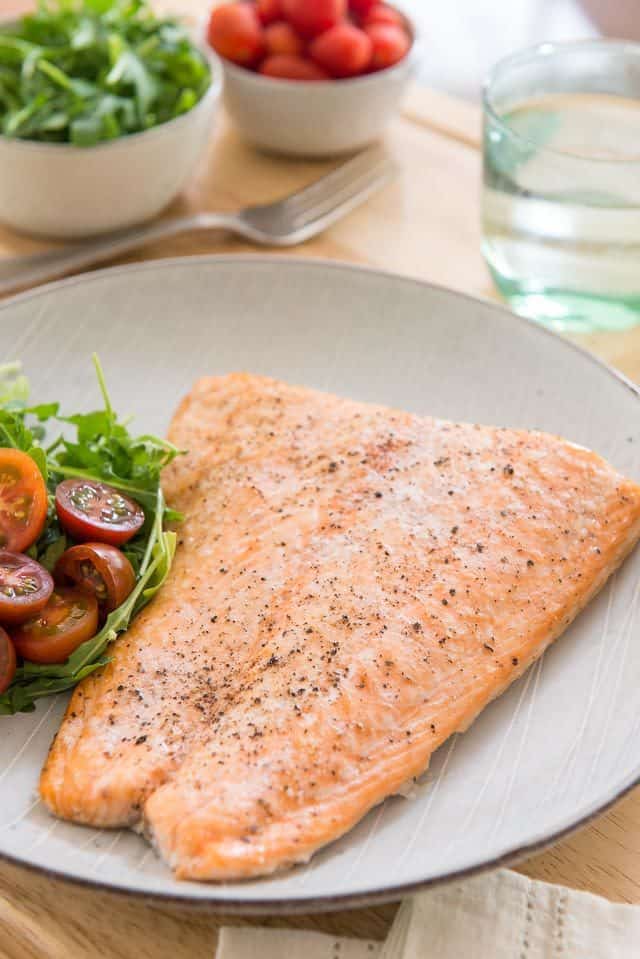
I’m not exaggerating when I say that I make this quick and easy baked salmon at least once a week. It’s an integral part of my meal prep and my family always loves eating salmon.
If I’m being honest about my favorite way to eat this popular fish, it’s hands down a pan seared Crispy Skin Salmon just like at the restaurant, where the skin is like a crunchy potato chip on top of the fish. However, that’s a more involved process that involves de-scaling the fish and perfecting the sear, and it’s only meant to be eaten right away.
This baked salmon is incredibly simple prepare, and you can enjoy the fish as is, with additional seasonings and flavors, or in other recipes altogether. I personally LOVE rubbing it with a little bit of homemade Cajun Seasoning (moistened with a touch of olive oil so the spices don’t burn). Leftovers also keep beautifully.
You can also make as little or as much as you want. When I’m serving a lot of people, I’ll cook a whole side of salmon, and the cook time is more or less the same as when I cook just a few filets.
Tips for the Perfect Baked Salmon
The type of salmon you use matters – Types of salmon vary wildly in terms of eating experience. Farmed species tend to be fattier (and therefore more moist) than wild-caught salmon, but even wild varieties vary tremendously from species to species. Scroll down to the Farmed vs. Wild-Caught Salmon section below for more details and my recommendations.
Try to get a center cut piece – If possible, ask the fishmonger to cut you a center-cut portion with an even thickness. This will help the fish cook more evenly, instead of having some overcooked or undercooked parts.
Aim for medium – Salmon is fully cooked at 140°F, but can generally be eaten safely at 125°F (medium). This gives you a more moist interior and delicious eating experience.
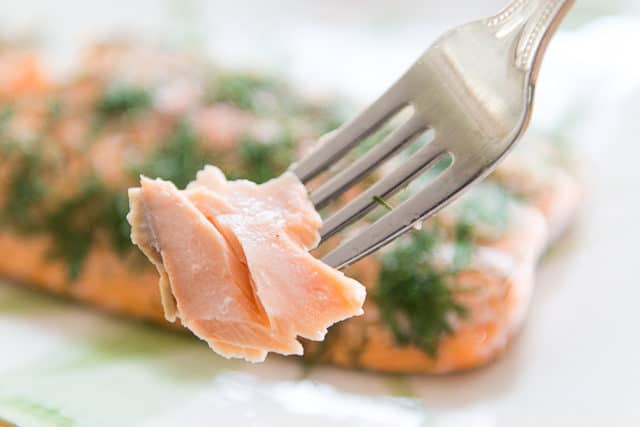
Cook for less time at a higher temp – Because I bake salmon so often, I’ve experimented with many different oven temperatures and cooking times. I find that oven-baked salmon cooks best at higher temperatures for a shorter time — I think 425°F is the best temperature. This gives you moist pieces that flake gently.
Farmed vs Wild-Caught Salmon
As a rule of thumb, wild-caught salmon — such as wild sockeye salmon — is generally less fatty than farm-raised salmon. This causes wild salmon to be more prone to becoming dry and overcooked.
I’ve tried 8 different types of farm-raised and wild salmon. My preference for wild is King salmon, but it’s also the most expensive.
My favorite budget option is Whole Foods Farmed Atlantic Salmon, which has great flavor and moisture. Sockeye salmon and Coho salmon species tend to be more dry, so be extra careful with overcooking. Avoid Chum salmon, which has an inferior flavor to other species.
How to Bake Salmon in the Oven
Step 1: Remove the Bones if Necessary
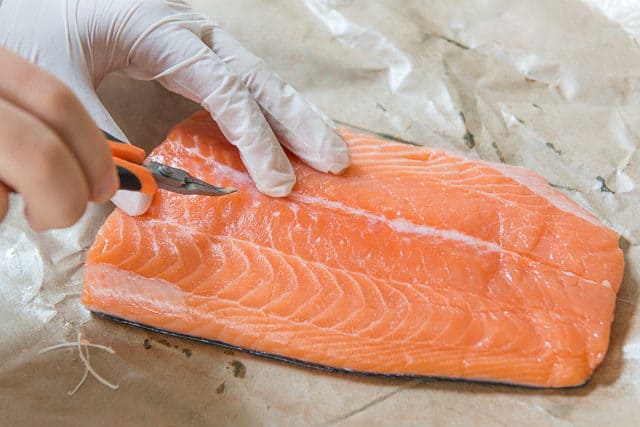
Sometimes the fishmonger has already removed the pinbones from the salmon. If not, you will need to do this yourself.
Do not skip this step! Pinbones are particularly big and thick and pose a choking hazard if left in.
This process is easiest with tweezers. Trust me, you cannot pull the bones out of the salmon with your fingers.
Because I make this baked salmon recipe so often, I have a pair of fish bone tweezers (affiliate), which is the easiest way to remove the bones. I’ve also been able to pull the bones out with tongs in a pinch, but it’s a little tedious and harder to grip.
To remove the bones, you can feel along the flesh to see where they are poking out, then grab them with the tweezers and work them out of the fish.
Step 2: Season the Fish
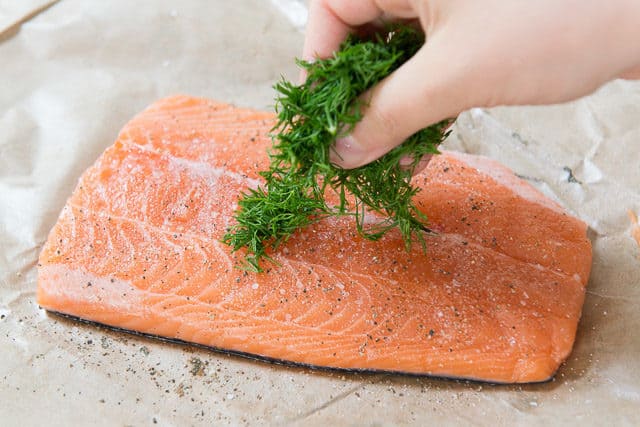
Next, season the fish generously with kosher salt and freshly cracked black pepper:
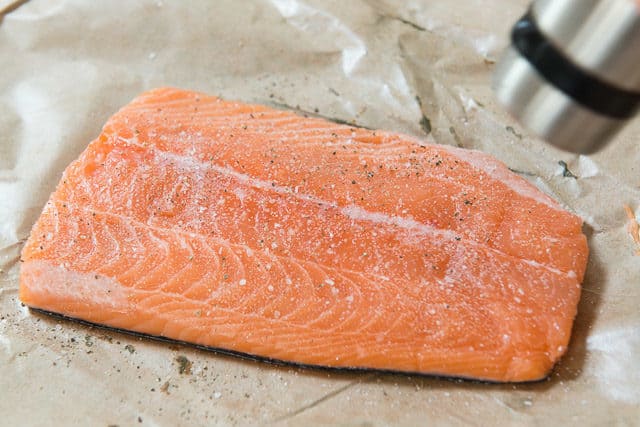
You can add other herbs, sauces, and seasonings if you like. Scroll down to Seasoning Variations below for some ideas.
Step 3: Bake
Next, I like to line a rimmed baking sheet with foil or a piece of parchment paper. I find that even if you grease the bottom of the pan with oil, the salmon skin always sticks anyway, and it’s a pain to scrub it off. So I make cleanup easy by lining my baking sheet.
On that note, I also do not bother patting any sides of the salmon dry with a paper towel, since we aren’t looking to accomplish much browning here. Save that for when you make pan-seared salmon.
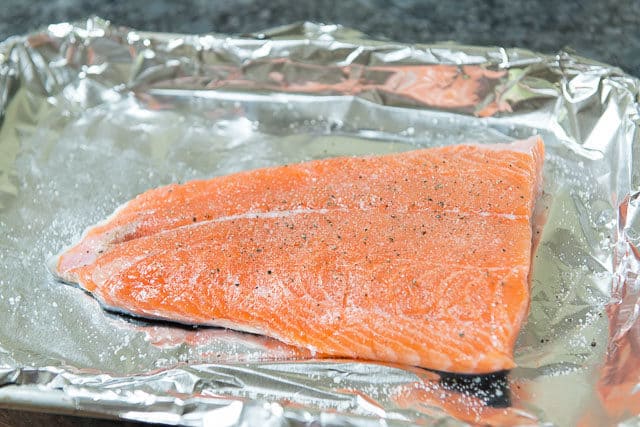
For a 1-inch-thick piece of salmon, bake at 425°F for about 12-14 minutes, or until the center of the fish reaches 125°F-130°F for medium or 140°F for well done. Check the temperature using an instant-read thermometer at the thickest part of the filet.
Serve the baked salmon right away for the best flavor and texture.
How Long to Bake Salmon
How long your salmon needs to bake will depend on the thickness of your filet. For a filet about 1-inch thick, I find that 12-14 minutes at 425°F is perfect.
If you have an instant-read thermometer, check for doneness by inserting the thermometer into the thickest part of the filet. Medium is 125°F-130°F while well done is 140°F. Slightly undercooking is the key to tender salmon, so I like to aim for around 125°F.
If you don’t have a thermometer, look at the color and texture of the fish to determine doneness. The Salmon should change from a deep pink/orange with a shiny/glossy exterior to a lighter orange and opaque exterior. One the shiny exterior disappears, the fish should be done within a minute or two.
If you’re using a wild-caught variety, you’ll want to watch the fish very closely, as there’s less fat there and it’s easier for it to overcook and dry out.

Seasoning Variations
If I’m baking salmon to use on top of a salad or in other recipes, I keep the seasoning simple with just salt and pepper.
But I also love to change up the seasonings, especially when I’m making this as an entree for dinner.
Some of my favorite ways to flavor this baked salmon include:
- Brush the fish with melted butter. If you do this, keep in mind that it will brown a bit in the oven.
- Add fresh herbs such as chopped fresh dill.
- Top the fish with sauces such as Dijon mustard mixed with pure maple syrup, basil pesto, or teriyaki sauce.
- Sprinkle on spices such as Cajun seasoning, lemon pepper, or simply some smoked paprika.
If you are using a seasoning blend that contains salt, keep in mind that you may not need to add much additional salt to the fish.
Serving Suggestions
Serve baked salmon immediately after removing it from the oven, when it’s at its peak juiciness and moisture.
You can serve it with light side dishes like Roasted Parsnips, my favorite Cilantro Lime Cauliflower Rice, a fresh Greek Zucchini Salad, or my Carrot Raisin Salad.
A simple squeeze of lemon juice is also nice! You can serve the fish with lemon slices on the plate, so people can decide for themselves if they’d like to add some lemon to their portion.
If you’d like to add a sauce, I recommend Basil Pesto, Romesco, or Cilantro Jalapeño Sauce. A simple lemon butter (equal parts by weight of both) is also a delicious sauce that’s easy to make quickly.
You can also use this as the main protein for salads like Cobb Salad or Kale Salad.
If you have leftovers, you can use them to make my salmon cakes!
Recipe FAQ
Keep in an airtight container in the fridge for up to 5 days. Try to finish it in 3-4 days for optimal flavor.
Yes, freeze it in an airtight container for up to 3 months. To thaw, leave it in the refrigerator overnight.
The best options are in the microwave or in the oven. For the microwave, do 30-second intervals at 50% power, until warmed through, being very careful not to overcook the fish. For the oven, try 300°F for 10 minutes, until warmed through.
Tried this recipe? Leave a rating and comment below — I’d love to hear how it turned out! Or, follow me on Facebook, Instagram or Pinterest!
Baked Salmon
Ingredients
- 1 pound fillet of salmon see notes
- 1/2 teaspoon kosher salt
- 1/4 teaspoon freshly ground black pepper
Equipment
Instructions
- Preheat the oven to 425°F. Line a baking tray with aluminum foil or parchment paper.
- Unless they've been removed already by the fishmonger, remove the pinbones from the fillet with tweezers.1 pound fillet of salmon
- Season the top of the fish generously with salt, about 1/2 tsp for a 1lb piece. I don't season the bottom of the fish, since I discard the skin.1/2 teaspoon kosher salt
- Add freshly ground black pepper to the fillet, about 1/4 tsp, or to your taste.1/4 teaspoon freshly ground black pepper
- Place the fish on the lined tray, and bake for 12-14 minutes, until the top is no longer shiny and the fish registers between 125°F-140°F in the middle, depending on desired doneness. 125°F is for medium, and 140°F is for fully cooked.
- Serve and enjoy!
Notes
Nutrition
Nutrition is estimated using a food database and is only intended to be used as a guideline for informational purposes.
This post contains affiliate links.
39 Comments on “Quick and Easy Baked Salmon”
Thank you so much for this wonderful guide to cooking salmon! I used it to cook two small salmon pieces for a surf and turf meal and it turned out absolutely perfect! I served small salmon pieces (slices of filets) with a lemon dill sauce from Publix with filet steaks marinated with Worcestershire, spicy mustard, soy sauce and Cajun seasoning, with sides of steamed broccoli and fried garlic bread. My husband raved about it to friends and family for days! Your research and tips definitely paid off to bring an amazing meal to my table, so thank you again for the recipe and best practices!!!
Delicious! I brush a very small amount of melted butter on my salmon fillet squeeze a little fresh lemon juice, salt and pepper my salmon and bake as directed until 140 degrees. I like mine moist but cooked through.
Actually that’s what I’m preparing for dinner tonight.
YUMMY!
This is THE BEST way to cook salmon. I’ve been grilling it for years and thought it was good but this method cooks it perfectly. I use an oven probe and set it to 126 degrees. It’s sooooo good! Thank you for sharing.
I put a layer of olive oil on the salmon before any spices. It adds a certain flavor to the mix and also seems to keep in the moisture. Even chicken parm, coating with olive oil is better at holding the bread crumbs and the chicken always seems to come out moist. Could it possibly seal it in? Dunno – try it and see for yourself
Very easy and very good, as advertised. I add a bit of lemon juice over the top, and seasoned pepper, etc… just whatever comes to mind at the time.
There’s a comment in the narrative about the skin side sticking to the pan. I like to eat the skin, and DON’T have that sticking problem by using the foil as recommended to line the pan and spray a little cooking oil, like Pam, on the foil.
I found it took a full 20 minutes to raise the salmon to 140 degrees at the oven tested temperature of 425 degrees. Otherwise very good.
Superb recipe! Incredible
I loved it!
Thanks so much for these instructions! I used to be too nervous to try and cook salmon. My salmon took longer to cook, but thanks to your instructions about the internal temperature, I was able to get it out of the oven fully cooked, but not dry.
Hi Eve, this is great to hear, glad the salmon turned out well!
where is the most responsible place to buy salmon at what store?
Hi Maureen, this is a somewhat loaded question (haha) but I think it’s first more a matter of if you’re buying wild or farmed salmon. Which do you typically get? I like to buy my salmon from Whole Foods (both farmed and wild), but I think there are places online where you can order quality salmon as well, such as Thrive Market.
Salmon is so simple and delicious!
So simple, yet such a great dinner recipe.
Perfection! It’s our favorite!
I love this! Thanks so much for sharing!
Such a great weeknight dinner that is also super healthy. Make this all the time.
Thanks!
Great tips! I love grilling salmon in the summer, but this is perfect for when I make salmon salad or add salmon to a green salad in the winter!