

Leg of Lamb
This roasted leg of lamb is cooked in the oven using the reverse sear method, resulting in the most perfectly cooked meat. I love making this lamb leg recipe for holidays like Easter and special dinners, along with a side of Roasted Carrots!
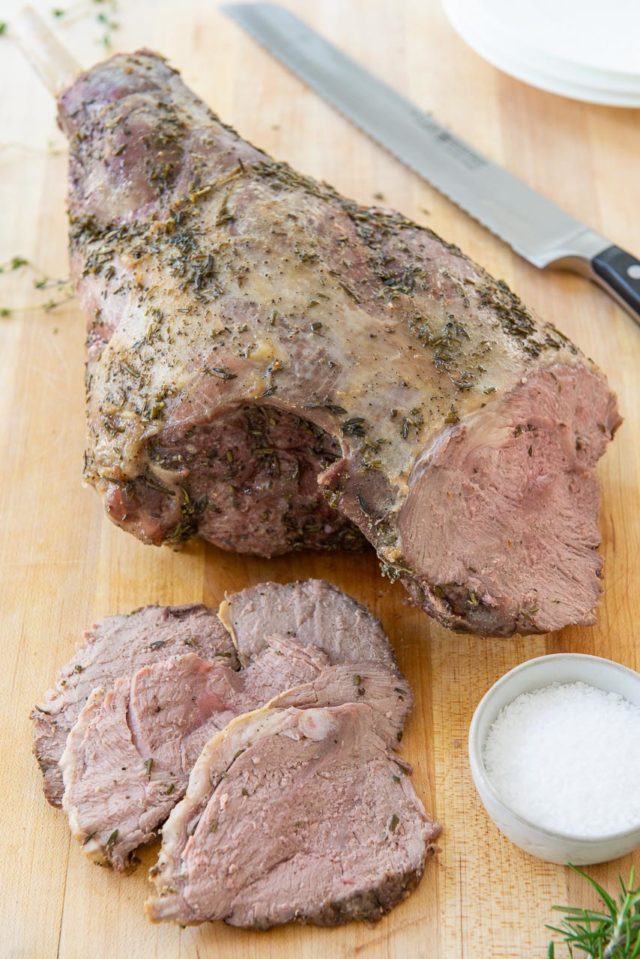
Much like my Prime Rib, this is the most epic way I know for making Leg of Lamb, and it’s all thanks to the reverse sear.
This lamb leg recipe is perfect for any holiday, whether it be Easter or Christmas dinner. It’s also easy enough to make for a dinner party or special celebration dinner.
Once you give it a try, you’ll be looking for reasons to make roasted leg of lamb!
What is Reverse Searing?
Reverse searing is a method of cooking meat that starts with cooking the meat slowly until it has reached the desired internal temperature. Then the meat is finished with quick, high-heat cooking to sear it on the outside.
This is a method that is commonly used for cooking steaks, but can also be used in the oven for cooking larger cuts of meat, such as leg of lamb or prime rib.
In this leg lamb recipe, the meat is cooked low and slow in a gentle oven, then rests briefly before being blasted in a hot oven for a few minutes to brown the outside.
Why You’ll Love Reverse Searing Leg of Lamb
Perfectly cooked meat: Reverse searing your lamb leg makes for an evenly tender and pinkish interior all the way to the edges, while still giving you a well-browned exterior. That means no gray, overcooked edges on the meat, like with many other methods.
You can serve the lamb hot from the oven: Because you let the lamb rest after the initial cooking, then blast it in the hot oven to brown it, you can serve the lamb immediately. You have already done the resting period, so you can take the meat right from the oven to the table without worrying about the juices spilling out when slicing. And the meat is still warm!
Great for holiday dinner prep: You can finish prepping the rest of your sides, such as saffron rice, my favorite cauliflower mashed potatoes, or a classic potato gratin, while you’re waiting for the lamb to rest.

How to Cook Leg of Lamb
As a summary, we rub the lamb with an herb black pepper mixture, then roast in a low oven for 90 minutes, rest it for 30 minutes, then blast it at high heat for 5 minutes to brown the outside. That’s it!
Make the Herb Black Pepper Coating
In a small bowl, combine ghee, fresh chopped rosemary, fresh thyme leaves, freshly ground black pepper, and salt:

Ghee is superior to olive oil here, and it’s always my go-to choice for high heat roasted meats.
It has a neutral flavor, a very high smoke point, and a great consistency for slathering on the meat and holding all the seasoning evenly in place.
You may also notice there’s no garlic here, and believe me, I love garlic! But it’s not a good ingredient in this lamb leg recipe. It tends to burn in the oven and when I tested this recipe with garlic, I found the strength of the flavor to be a bit offensive. Don’t be tempted to add garlic to this recipe.
Place the leg of lamb on a sheet pan with a wire rack set inside. You could also use a roasting pan with a rack set inside. Blot as much moisture away from the meat as you can with a paper towel, then scrape the herb paste onto the meat:
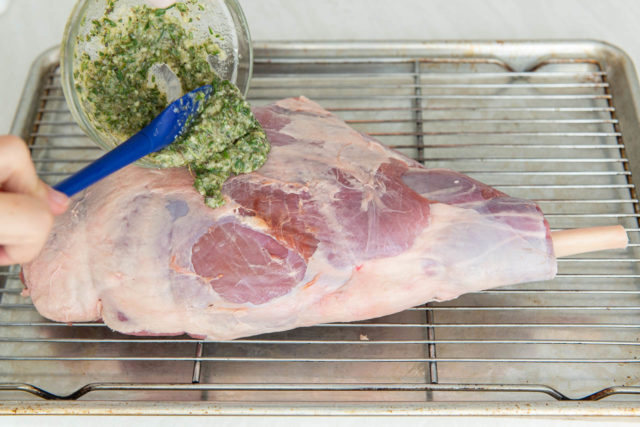
Spread to Coat
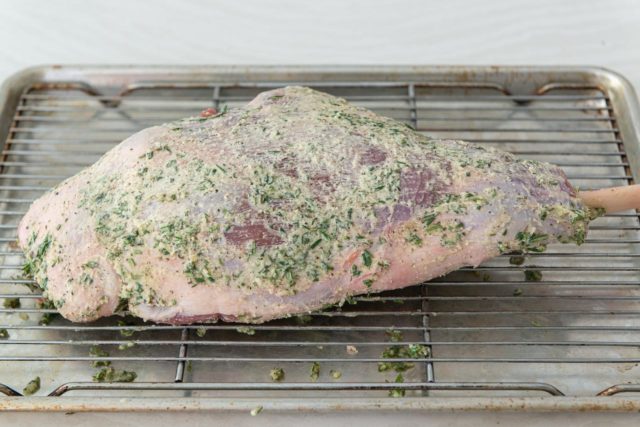
Spread the paste out evenly using a spatula or your hands. Make sure to get it all over the underside too, though I do like to concentrate more of it on top.

You may notice that I’m using a Frenched Leg of Lamb here, meaning the bone at the end has been prepared so that the meat is cut away and the bone is exposed.
A lot of time you buy it already like this from the store, or if you buy your lamb from a reputable butcher, you can ask them to do it for you. But I also have a quick visual guide for How to French a Leg of Lamb if you would like to do it yourself. It only takes a minute, and I love the presentation.
Let the Lamb Sit at Room Temperature for an Hour
Before cooking any meat, I like to rest it at room temperature. It really does make a big difference in juiciness. Let the lamb sit uncovered for one hour:
Roast the Leg of Lamb at a Low Temperature to Start
Next, place the lamb in a 250℉ oven for anywhere from 90 minutes to two hours:
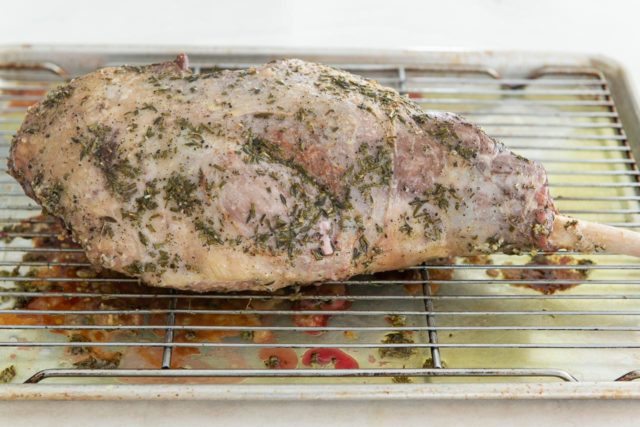
There are more notes on this in Leg of Lamb Internal Temperatures below, but unlike prime rib or Rack of Lamb, I don’t like leg of lamb cooked too rare. I personally think it tastes better more on the medium well side, so I go closer to the two hour mark and aim for an internal temperature of about 135℉.
Because of carry-over cooking, aim to pull the meat from the oven about 5 degrees shy of your preferred doneness. The meat will reach the preferred internal temperature as it rests.
Rest, Then Blast with High Heat for 5 Minutes
Let the lamb rest at room temperature for 30 minutes, then place it in a 500℉ oven for 5 minutes.
When you look at the photo below compared to the one above, you can see that it browns significantly during this short period.
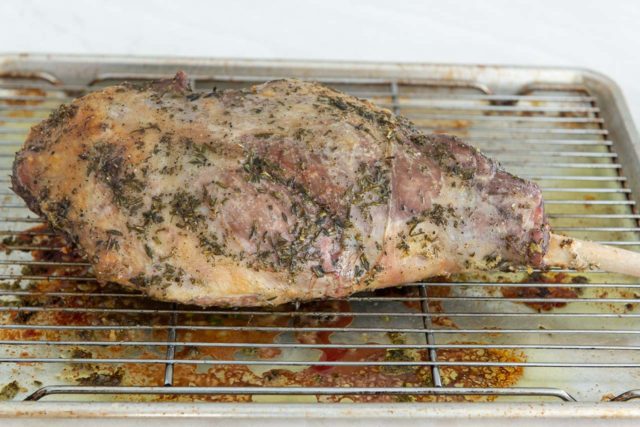
I recommend turning on the oven light and watching the meat so you can call it when it’s done, especially since things can get smoky (it’s worth it though).
You’ll see the skin popping up and sputtering like bacon in a skillet, and the outside will brown considerably.
Slice and Serve Right Away
As I mention above, part of the gloriousness of this method is you can slice and serve right away, since you already rested the meat!
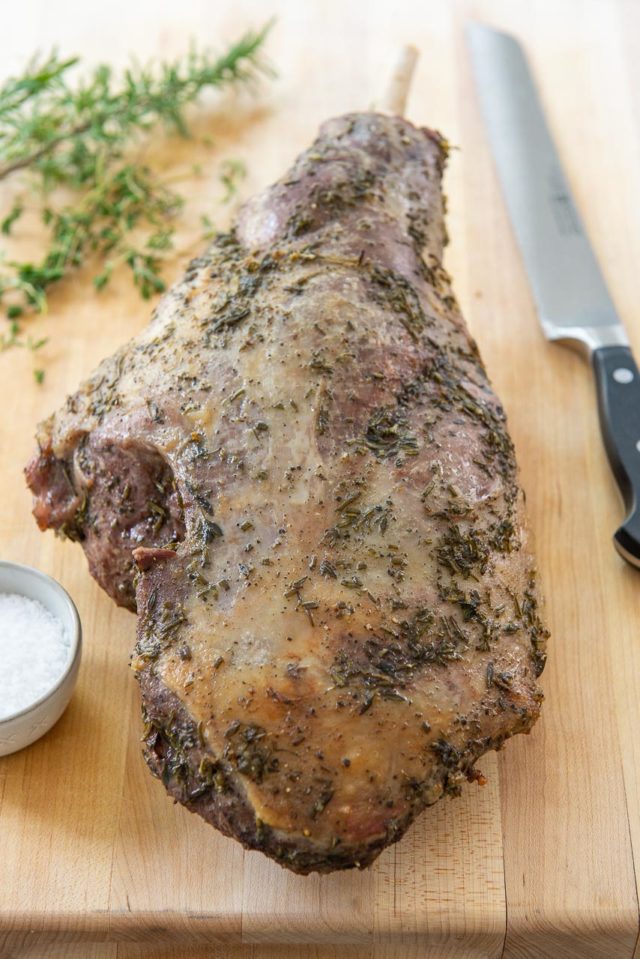
I don’t have a particular method for carving (I just stagger the angle as I go to avoid the bone), but there are many videos online that show how to carve a bone-in leg of lamb if you want something more outlined.
Braised Lamb Shanks are another great lamb dish worthy of the holidays, and I also love Beef Wellington. Enjoy!
Leg of Lamb Internal Temperatures and Cooking Times
Leg of lamb can be served anywhere from rare to well done. Just keep in mind that the USDA recommends cooking any cut of lamb (except for ground lamb) to 145℉.
For roasting a bone-in leg of lamb, keep these internal temperatures and approximate cooking times in mind:
- For rare: 125℉, about 10 minutes per pound
- For medium rare: 130-135℉, about 15 minutes per pound
- For medium: 135-140℉, about 20 minutes per pound
- For well done: 155-160℉, about 25 minutes per pound
When checking the doneness, insert an instant-read meat thermometer into the thickest part of the meat, taking care not to touch the bone with the thermometer.
Because the meat will continue to carry over another 5-10 degrees as it rests, pull the meat from the oven about 5 degrees before it reaches your preferred doneness.
Serving Suggestions
This slow-roasted lamb is incredibly versatile, so you can serve it for just about any holiday or occasion.
Mint is a very popular accompaniment to lamb because the flavors pair so nicely together. You can serve your lamb leg with any kind of mint sauce, such as mint chimichurri or a mint yogurt sauce.
While a classic chimichurri is more commonly served with beef or chicken, it would also be lovely with this lamb. You could also try using the pan drippings to make lamb gravy.
Storage and Reheating Tips
If I’m being honest, leftover lamb is not my favorite, even as someone who loves leftovers. I definitely find reheating it in the oven to be the best way to go.
Store leftover roast leg of lamb either sliced or as a whole piece in an airtight container in the refrigerator for up to 3 days.
To reheat, wrap the lamb in aluminum foil and place in a 250℉ oven for about 20-30 minutes, until the meat is warmed through to the center.
I do not recommend microwaving leftover lamb. But if you must, do so at 50% power and reheat it gently.
Lamb, like most meats, freezes well. Store in an airtight container in the freezer for up to 2 months.
Frequently Asked Questions
Absolutely. You can use any fresh herbs you like best — oregano would be a great one to use. You can even add some lemon zest for a different flavor profile. As stated above, I do not recommend garlic.
If you don’t have fresh herbs, use dried herbs but use just 1/3 the stated amount. Dried herbs have a much stronger flavor than fresh herbs.
I recommend planning to serve about 1/2 pound of meat per person. When buying a bone-in leg of lamb, the bone will weigh about 2 pounds. Subtract pounds from the total weight of the roast to calculate how much meat you will have. (For example, a 5-pound bone-in leg of lamb will yield around 3 pounds of meat, enough for 6 people.)
Yes. When using a boneless lamb leg, you will need to add about 5 minutes per pound of meat to the cooking time for your desired doneness, since boneless meat cooks slower than bone-in meat does.
Roasted Leg of Lamb
Ingredients
- 5 pound bone-in leg of lamb see notes
- 1/4 cup ghee
- 2 tablespoons chopped fresh rosemary leaves
- 1 tablespoon fresh thyme leaves
- 1 tablespoon freshly ground black pepper
- 4 teaspoon kosher salt
Instructions
- Set a wire rack inside of a half sheet pan.
- If you prefer the presentation, French the bone on the lamb (see my visual guide for How to French a Leg of Lamb). Set the lamb on the wire rack.5 pound bone-in leg of lamb
- In a small bowl, stir to combine the ghee, rosemary, thyme, black pepper, and salt.1/4 cup ghee, 2 tablespoons chopped fresh rosemary leaves, 1 tablespoon fresh thyme leaves, 1 tablespoon freshly ground black pepper, 4 teaspoon kosher salt
- Rub this mixture all over the leg of lamb, making sure to get the underside of the meat. Let the lamb sit at room temperature uncovered for one hour. About 15 minutes before the hour is up, preheat the oven to 250℉.
- Place the lamb in the oven and cook for 90 minutes to 2 hours, depending on desired doneness. Around the 90-minute mark, begin checking the lamb with an instant-read or meat thermometer inserted into the thickest part of the meat (make sure the thermometer does not touch the bone).
- When the internal temperature is about 5 degrees below your target doneness (see notes below), remove the roast from the oven and let rest for 30 minutes at room temperature.
- While the lamb rests, increase the oven temperature as high as it will go, ideally 500℉. If your oven has a convection feature, turn that on too.
- Place the lamb back in the oven for about 5 minutes to brown the exterior. Turn the oven light on and watch through the glass to ensure the outside doesn't get too brown (and to make sure things don't get too smoky). The lamb is ready when you can see the skin popping off and sputtering like bacon in a skillet.
- Remove the lamb, then slice and serve right away. No need to rest again. Enjoy!
Notes
- For rare: 125℉, about 10 minutes per pound
- For medium-rare: 130-135℉, about 15 minutes per pound
- For medium: 135-140℉, about 20 minutes per pound
- For well-done: 155-160℉, about 25 minutes per pound
Nutrition
Nutrition is estimated using a food database and is only intended to be used as a guideline for informational purposes.
4 Comments on “Leg of Lamb”
First time to cook Don’t know what to do . Some say cook at 200 for 5 hours ?
I was looking for an Easter lamb recipe with no garlic, so my cat could have some (she loves any kind of roast meat but garlic is poisonous to cats). I followed your directions with a few twists…
1) I put the salt on 24 hours before and did a dry brine in the fridge, rubbing on the rest an hour before cooking.
2) I did the long cook at 200 in a convection oven – took longer but I think longer and slower makes it more tender
3) I took it out of the slow oven at 120, because I like lamb more rare/medium rare. During the rest it rose to 127 and fell back to 125. Didn’t rise during the sear.
It came out perfect to my tastes!
So glad to hear it came out purfect! Thanks Will!
Your marinade looks terrific, so I am going to try this for Easter tomorrow. My leg of lamb is deboned, so how would you suggest to change the timing? Thank you!