

Homemade Caesar Dressing (Traditional & Shortcut Versions)
Making homemade Ceasar dressing makes all the difference for the very best Caesar salad! Learn how to make a traditional Caesar dressing completely from scratch in just 10 minutes, no fancy equipment needed, or whip up an even easier shortcut version for when you’re out of time. This dressing has the perfect balance of tangy and umami flavors with the absolute perfect creamy texture.
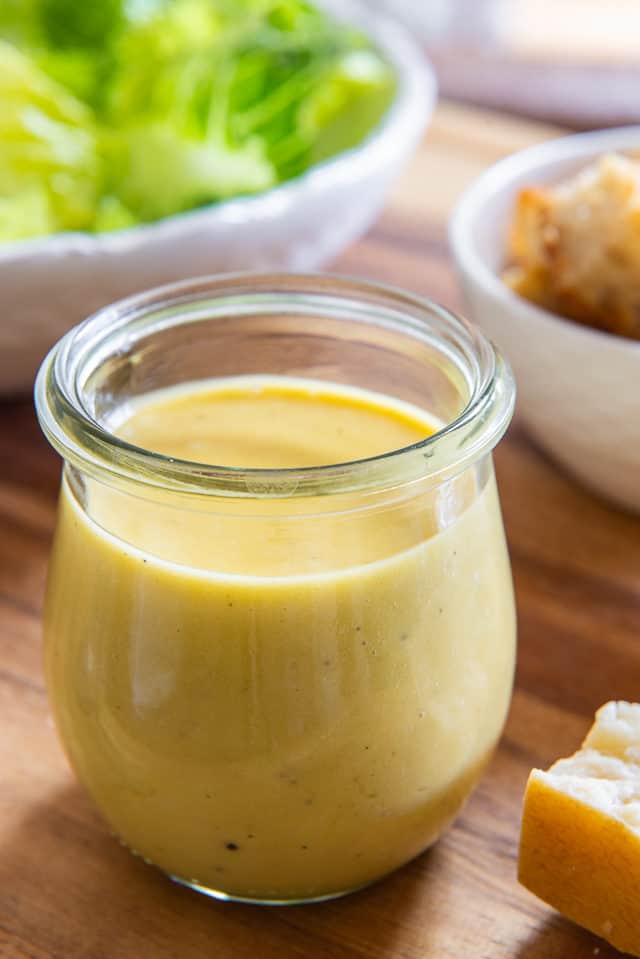
There’s nothing quite like getting a Caesar salad at a steakhouse, right? The reason those restaurant salads always taste better than the ones you make at home is in the dressing.
A really good restaurant is making their own Caesar dressing from scratch. Bottled dressing from the store just never has the same bold flavors or quite the right creaminess to make a from-scratch dressing.
But I’m going to teach you everything I’ve learned about making homemade Caesar dressing with unmatched flavor and richness. I absolutely love making this recipe completely from scratch; it can be done by hand in about 10 minutes, no fancy equipment needed.
But if you need an even faster shortcut? That’s ok, I’ll give you a “semi-homemade” version to make when you only have about 5 minutes.
I have to warn you: Once you start making Caesar dressing yourself, you’ll never want to go back to the store-bought stuff again.
What Readers are Saying:
“I found this recipe years ago and have made this so many times- exact to recipe- I get more compliments on this Caesar than I can count. Just wanted you to know it is a perfect recipe!” -Deb
Traditional vs Shortcut Caesar Dressing
Truly authentic Caesar dressing is made from scratch by emulsifying egg yolks and oil to create a rich, creamy base that evenly coats salad greens. It’s the same method that’s used to make homemade mayonnaise and aioli. It’s the added ingredients that take the flavor and texture from mayo to Caesar dressing.
One of the most important ingredients for an authentic Caesar dressing is anchovies. I promise it doesn’t make the dressing taste “fishy.” Instead, it adds that briny umami note that makes restaurant Caesar dressings taste so good.
I’m going to walk you through each step of making my traditional Caesar dressing recipe so you can see how easy it is. But if you’re still intimidated or if you just don’t have time to make it from scratch, I’ll also share a shortcut version with a mayonnaise base. (Head down to “5-Minute Shortcut Version” to check it out!)

Recipe Testing Notes
I’ve made this recipe countless times. Here’s what I’ve learned over the years when it comes to making the very best homemade Caesar dressing:
Use the freshest eggs possible – Don’t use eggs that have been in your fridge for a month. Pick up fresh eggs from the store when you want to make Caesar dressing. In addition to tasting better, fresh eggs are also more stable and less likely to split when emulsifying them with the oil.
Use anchovy paste – I find that anchovy paste distributed better into the dressing than chopped anchovy fillets. Plus, it makes one less prep step for you and it’ll keep in the fridge easily for the next time you want to make this dressing or even pasta puttanesca.
Chill before serving, if possible – In addition to giving the flavors time to meld together, I find that Caesar salad tastes even more incredible when all of the ingredients are really cold because the salad tastes extra refreshing.
The Ingredients and What They Do in This Recipe
For a traditional, from-scratch Caesar dressing, you will need:
- Egg yolks: The fat from egg yolks is what will emulsify with the oil to create that thick, creamy texture we want. I prefer to use only yolks in this recipe. Save the whites (you can freeze them!) for making angel food cake or coconut macaroons. Since the eggs will not be cooked, I recommend purchasing pasteurized eggs.
- Lemon juice: The acid from lemon juice cuts through the richness of the yolks and oil to brighten up the dressing. Always use fresh squeezed lemon juice in this recipe. Bottled juice just doesn’t taste as good.
- Anchovy paste: Like I mentioned before, anchovy paste gives the dressing its characteristic umami flavor. You can find anchovy paste in tubes at most mainstream grocery stores.
- Dijon mustard: Mustard is critical in helping emulsify the eggs and oil and bring the dressing together. Dijon mustard has a lovely tanginess that complements the flavors of the lemon juice and anchovies in this recipe.
- Garlic clove: A single clove of garlic adds flavor to the dressing without overpowering the other ingredients. You can finely mince it, press it in a garlic press (affiliate), or grate it with a microplane.
- Salt and pepper
- Olive oil: I use a lightly flavored olive oil, rather than a more strongly flavored extra virgin olive oil. Avocado oil would also be a great substitute.
- Parmigiano-Reggiano cheese: Another must for a really great Caesar dressing! I prefer to finely grate it myself so it mixes well into the dressing.
How to Make Traditional Caesar Dressing
The only equipment you really need to make my homemade Caesar dressing is a bowl and a whisk.
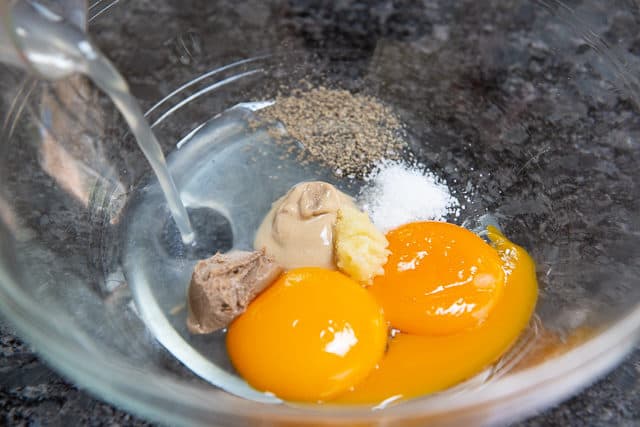
In a medium bowl, combine the raw egg yolks, lemon juice, anchovy paste, mustard, garlic, and salt and pepper. This recipe only makes about 1 cup of dressing, but use a bigger bowl than you think you need so that you have lots of room for whisking:
Whisk everything very well to combine it. Whisking this base well before adding the oil helps the dressing emulsify better and protects against it splitting.
Now, very slowly start to drizzle in the oil, whisking vigorously as you do.
You want to start with just a few drops at first, then slowly drizzle in more oil in a steady stream over a minute or two.
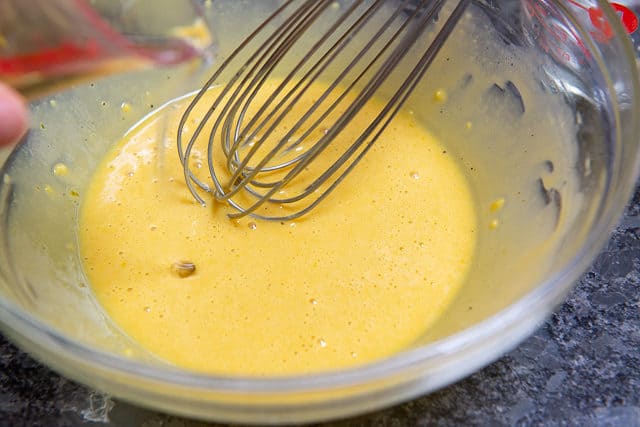
Add the oil slowly gives a thicker and creamier texture and helps keep the dressing from splitting.
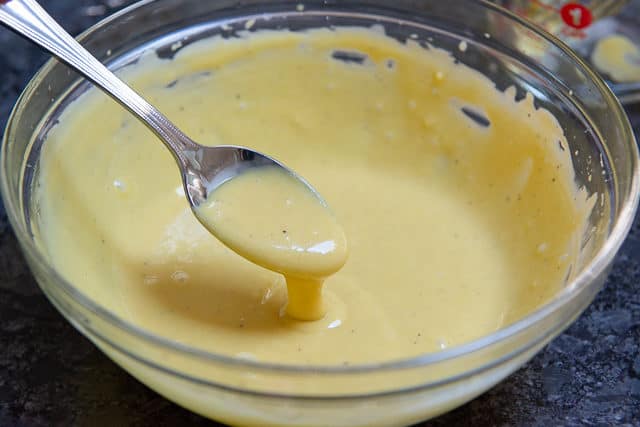
Eventually the dressing will look thick and creamy, like this:
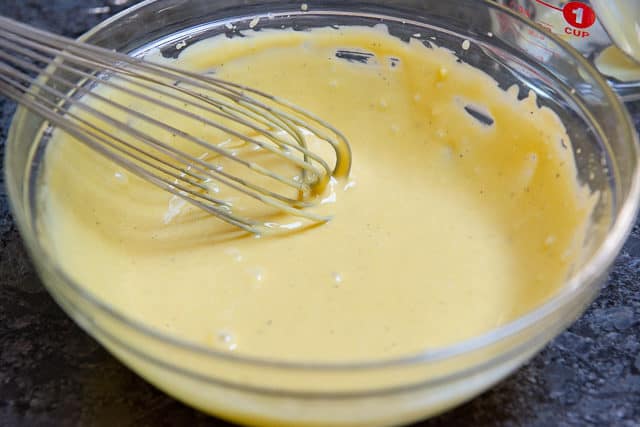
It should still have a flowy texture to it, but with a thickness and richness that clings to the spoon:
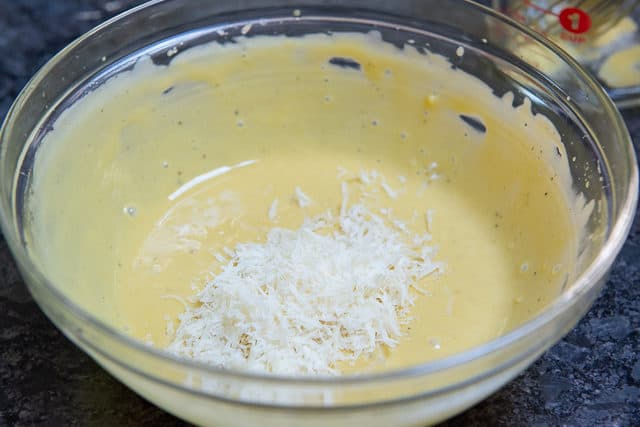
To finish the dressing off, add the grated Parmigiano-Reggiano cheese:
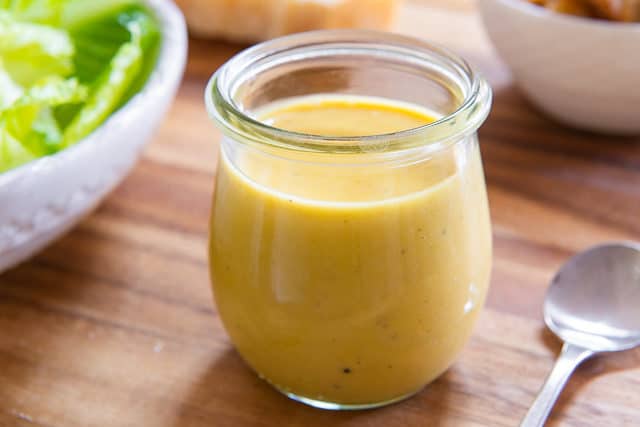
Before serving, make sure you give the dressing a taste for seasoning, adding more salt and/or black pepper if desired. You can even add a bit more lemon juice or anchovy paste if desired.
Tips to Prevent Splitting
With oil-based sauces such as mayonnaise and this Caesar dressing, it’s very hard to “rescue” the sauce after it splits. Your best bet is to use a few tricks to prevent the sauce from splitting in the first place:
- Use fresh eggs: Fresher eggs are more stable and less likely to split from the oil.
- Whisk the eggs very well before adding the oil: Make sure you whisk the egg yolks with the lemon, mustard, and other ingredients very well before you start streaming in the oil.
- Add the oil slowly: Don’t just pour it in! Start with a very slow stream at first, then you can increase the speed as the dressing starts to come together. I find that it can help to use a squeeze bottle (affiliate) for adding the oil.
- When in doubt, use an immersion blender: If you are still having trouble, try using an immersion blender (affiliate) instead of whisking by hand. I very rarely experience splitting when using an immersion blender. Keep in mind that a regular blender or food processor doesn’t work as well, though, because the motor heats the sauce as it mixes.
5-Minute Shortcut Version
Still a bit scared to try making homemade Caesar dressing the traditional way, or just don’t have more than a few minutes to throw together a dressing? Use this simple shortcut version instead.
For the super-quick version, you’ll need:
- 2/3 cup high-quality mayonnaise
- 2 tablespoons grated Parmigiano-Reggiano cheese
- 1 tablespoon freshly squeezed lemon juice
- 2 teaspoon anchovy paste
- 1 teaspoon Dijon mustard
- 1 garlic clove, pressed or minced
- Pinch of salt and black pepper
Whisk everything together in a bowl until well combined. Taste and adjust for seasoning as needed, adding more salt and pepper, lemon juice, etc, as desired. If possible, let the dressing chill in the fridge for a couple of hours before serving.
Serving Suggestions
Even though a restaurant-style Caesar salad is the ultimate way to use your homemade Caesar dressing, it’s not the only way!
- Serve it as a sauce for proteins such as grilled chicken breast or pan-seared salmon.
- Use it as a spread for wraps and sandwiches.
- Toss it with roasted vegetables like roasted cauliflower or roasted fennel.
- Use it as a dip for everything from crispy baked chicken wings to the perfect homemade French fries.
Frequently Asked Questions
To get the same rich flavor that you find in restaurant Caesar dressing? Yes. But if you really don’t want to use them and are ok with the flavor being slightly different, you can use 1 teaspoon Worcestershire sauce or 1/2 teaspoon to 1 teaspoon of white miso paste instead.
This is not recommended, because it will wreck the texture of the dressing and you won’t be able to bring it back together.
Tried this recipe? Leave a rating and comment below — I’d love to hear how it turned out! Or, follow me on Facebook, Instagram or Pinterest!
Caesar Dressing
Ingredients
- 2 large egg yolks pasteurized recommended
- 1 tablespoon fresh lemon juice
- 1 teaspoon anchovy paste
- 1 teaspoon Dijon mustard
- 1 garlic clove pressed or minced
- ½ teaspoon salt
- ¼ teaspoon black pepper
- ½ cup olive oil or other neutral-flavored oil
- 2 tablespoons freshly grated Parmigiano-Reggiano cheese
Equipment
Instructions
- In a medium bowl, whisk to combine the egg yolks, lemon juice, anchovy paste, dijon mustard, garlic, salt, and pepper, for about 30 seconds, until smooth and very well combined.2 large egg yolks, 1 tablespoon fresh lemon juice, 1 teaspoon anchovy paste, 1 teaspoon Dijon mustard, 1 garlic clove, ½ teaspoon salt, ¼ teaspoon black pepper
- While whisking constantly and vigorously, very slowly begin to add the oil, starting with a very slow drizzle, increasing into a more steady stream as the dressing begins to come together. Adding all of the oil should take anywhere from 60-90 seconds.½ cup olive oil
- At this point, the dressing should have a thick, creamy texture. Gently stir in the cheese, then taste and adjust seasoning as desired. Use right away or transfer to an airtight jar or bottle and store in the refrigerator until ready to use.2 tablespoons freshly grated Parmigiano-Reggiano cheese
Notes
Ingredients:
- Use fresh eggs for the best flavor. They are also more stable, making it less likely for the dressing to split while emulsifying.
- Anchovy paste is easier to mix into the dressing than chopped anchovy fillets. You can find anchovy paste in tubes in most mainstream grocery stores.
- Other oils that work well in this recipe include avocado oil, grapeseed oil, or even regular vegetable oil.
Assembly:
- If you are having trouble with the dressing splitting or whisking by hand is not accessible for you, try using an immersion blender instead. I do not recommend using a regular blender or food processor, since the motor can heat up the dressing, causing it to split.
5-Minute Shortcut Version:
- Whisk the lemon juice, anchovy paste, mustard, garlic, and a pinch of salt and pepper with 2/3 cup good-quality mayonnaise until well combined. Taste and adjust seasoning as desired. If possible, chill for a couple of hours before serving to allow the flavors to meld.
Storage:
- Store in an airtight container in the fridge for up to 5 days. Do not freeze.
Nutrition
Nutrition is estimated using a food database and is only intended to be used as a guideline for informational purposes.
36 Comments on “Homemade Caesar Dressing (Traditional & Shortcut Versions)”
I found this recipe years ago and have made this so many times- exact to recipe- I get more compliments on this Caesar than I can count. Just wanted you to know it is a perfect recipe!
wow! Thats great to hear! Thank you Deb!
Amy D….something else???
Excellent. Followed the recipe exactly as written. I would definitely make it again, just add less salt.
Thanks Laura! Cheers!
Very nice and easy to make. I did replace the anchovy paste with about 5-6 anchovies. I also used avocado oil after reading reviews. It was a tad thick but instead of adding water I used some additional lemon juice, tasting as I went along.
Thank you! Im glad you enjoyed this one!
I made this yesterday and it was really good. I did take the advice of another reviewer however, and had to make a 2nd batch with avocado oil instead of EVOO and the taste was waaaay better. The olive oil one was just bad but that could just be the brand that I had on hand. I also added 2 teaspoons of water because without it, it was too thick. Other than that, great recipe.
Sorry, somehow my original comment ended up under another comment!
This is a really great recipe base if you’re wanting to avoid unhealthy seed (PUFA) oils!!! I had to make a few changes for it to work.
1) I tried with the olive oil, and it was… yucky. Like, a bitter aftertaste; just too… olive-oily? Caesar dressing really needs a more neutral flavoured oil. So I used avocado oil.
2) It was WAYYYYY too thick unless I added water. I added 2 tsp water, and it was still pretty thick, but more dressing-like. 3 tsp would probably be good as well!
3) I used an immersion blender, because, well, I’m lazy. 🙃 I threw everything in the bottom of a wide-mouthed mason jar (except for the oil and parmesan), blended it up, and then slowly poured in the avocado oil until it was done. Then I put it in something else using a rubber spatula, and mixed in the parmesan.
It tasted amazing!!!
Delicious!
I used an immersion blender, and added a touch more anchovy paste. So very good!
Thank you.
Simple, easy, and tastes better than more complicated recipes. I like to double the anchovy amount and subtract the salt.
I think the quality of the evoo makes or breaks it.
Thank you.